Autonomous Enterprise Workflows Using Collaborative AI Agents
Abstract
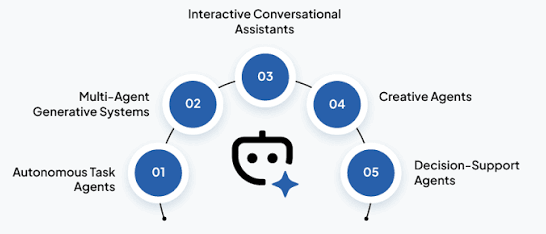
Autonomous enterprise workflows are emerging as a transformative approach to improving organizational productivity, operational efficiency, and decision-making. Collaborative Artificial Intelligence (AI) agents enable enterprises to automate complex business processes by coordinating specialized agents that perform tasks such as data analysis, document processing, compliance verification, customer support, and workflow management. Unlike conventional automation systems that follow predefined rules, collaborative AI agents can interpret contextual information, communicate with other agents, adapt to changing requirements, and coordinate multistep activities. This research explores the architecture, operational mechanisms, applications, benefits, and challenges of collaborative AI agents in enterprise environments. It also examines the importance of governance, security, human supervision, and performance evaluation in developing reliable autonomous workflows. The proposed approach highlights how coordinated AI agents can support scalable, context-aware, and intelligent enterprise operations. Keywords: Autonomous Workflows, Collaborative AI Agents, Enterprise Automation, Large Language Models, Intelligent Process Management, AI Governance.
Introduction
Modern enterprises manage increasingly complex business processes involving large volumes of structured and unstructured data, distributed applications, regulatory requirements, and cross-functional teams. Traditional workflow automation primarily relies on predefined rules, fixed sequences, and manual intervention when unexpected situations occur. Although these systems improve efficiency in repetitive operations, they often struggle with dynamic business environments that require contextual understanding and coordinated decision-making. Collaborative AI agents offer an alternative by introducing intelligent software entities capable of performing specialized tasks and cooperating to achieve shared objectives. For example, an enterprise procurement workflow may involve agents responsible for supplier evaluation, purchase-order validation, budget verification, compliance checking, and approval preparation. Each agent contributes domain-specific capabilities while exchanging relevant information with other agents. The objective of this research is to examine how collaborative AI agents can be integrated into autonomous enterprise workflows to improve operational efficiency, adaptability, transparency, and decision quality.
Architecture of Collaborative AI Agents
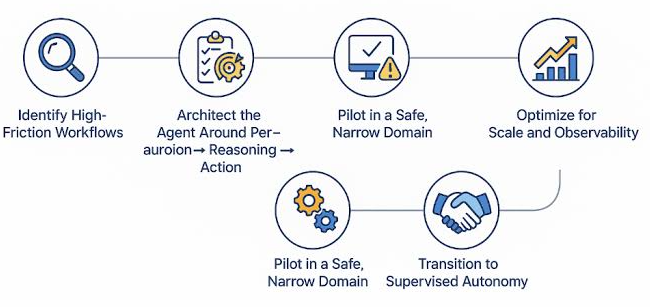
An autonomous enterprise workflow can be organized into five principal layers: the user interaction layer, orchestration layer, agent collaboration layer, enterprise integration layer, and governance layer. The user interaction layer receives business objectives through natural-language instructions, application interfaces, or predefined enterprise events. The orchestration layer interprets these objectives, decomposes them into manageable tasks, assigns responsibilities, and monitors execution progress. The agent collaboration layer contains specialized agents designed for particular business functions. A planning agent identifies the required activities, while execution agents perform assigned tasks. A validation agent checks outputs for completeness, accuracy, and policy compliance. A monitoring agent identifies failures and initiates recovery procedures when necessary. The enterprise integration layer connects agents with enterprise resource planning (ERP), customer relationship management (CRM), document management, financial systems, and internal knowledge repositories through controlled APIs and other approved interfaces. Finally, the governance layer enforces access controls, audit logging, approval requirements, data protection, and operational policies. This layered architecture supports modularity, controlled collaboration, and scalability across enterprise departments.
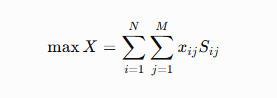
EQ.1. Collaborative Agent Task Allocation:
Operational Framework and Collaboration Mechanism
The proposed framework follows a goal-oriented process in which an enterprise objective is converted into a sequence of coordinated activities. Initially, the system interprets the request and identifies relevant business context. The orchestration agent then decomposes the objective into subtasks and assigns each task to the most appropriate specialized agent. Agents execute their responsibilities using authorized enterprise data and tools. Intermediate results are shared through structured messages or a common task repository. Other agents evaluate dependencies, identify inconsistencies, and request additional information when required. For instance, an invoice-processing workflow may begin with a document extraction agent identifying invoice details. A matching agent compares the extracted information with purchase orders and delivery records. A compliance agent checks applicable organizational policies, while a finance agent verifies payment conditions. If all required checks succeed, the workflow prepares the transaction for authorized approval. Exceptions, conflicting records, or high-value transactions are escalated to human personnel. The workflow continues until its completion criteria are satisfied or intervention becomes necessary. This approach combines autonomous task execution with explicit validation and human oversight.
Enterprise Applications
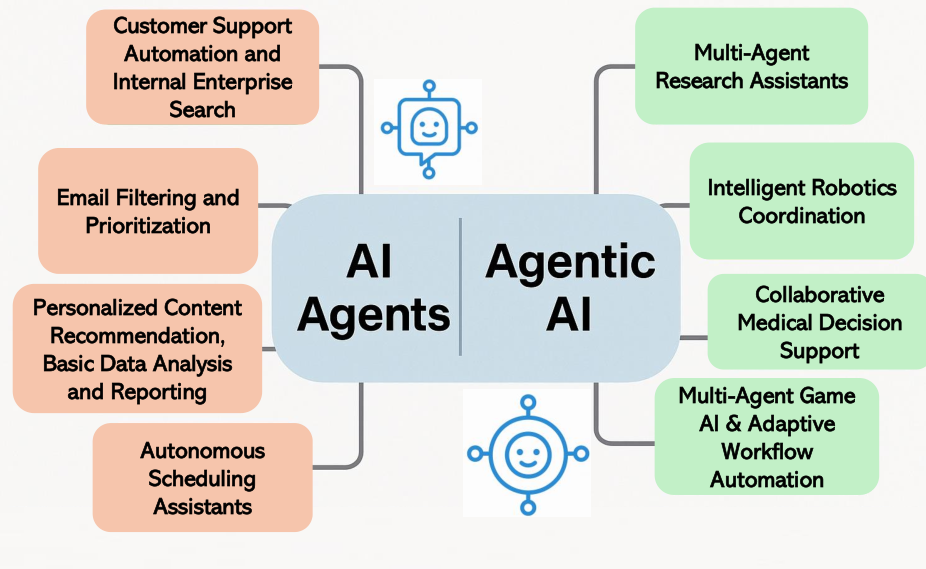
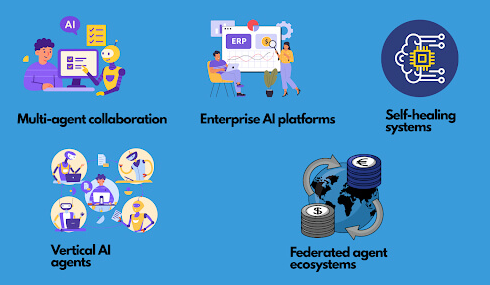
Collaborative AI agents can support a wide range of organizational activities. In customer service, agents can classify requests, retrieve relevant knowledge, draft responses, and coordinate case escalation. In IT service management, agents can analyze incident descriptions, correlate monitoring alerts, recommend remediation procedures, and update service records. High-impact infrastructure changes should remain subject to appropriate authorization. In finance, collaborative agents can assist with invoice reconciliation, expense validation, anomaly detection, and financial reporting. In human resource management, they can support onboarding documentation, employee inquiries, and policy-based request routing. Supply-chain operations can benefit from agents that monitor inventory, evaluate supplier information, and identify potential delivery disruptions. These applications demonstrate that collaboration enables multiple specialized capabilities to contribute to a single business outcome rather than automating isolated tasks independently.
Benefits and Performance Evaluation
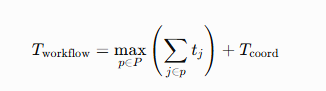
The primary benefits of collaborative AI workflows include reduced repetitive effort, faster information processing, improved coordination, and more consistent execution of organizational procedures. Reusable agents can also support workflow expansion across departments without requiring every process to be developed as a separate automation system. Performance should be evaluated using measurable indicators such as task completion rate, average processing time, error frequency, exception rate, operational cost, and human intervention frequency. Additional measures should assess security incidents, policy compliance, output accuracy, and traceability. Evaluation should compare the collaborative framework against existing workflows using representative enterprise tasks, consistent evaluation criteria, and realistic operational conditions. Baseline measurements are essential because introducing multiple agents may increase communication overhead, computational costs, and execution complexity. Therefore, improved performance should be demonstrated empirically rather than assumed.
EQ.2. Autonomous Workflow Execution Time:
Challenges and Governance Considerations
Despite their potential, collaborative AI agents introduce several challenges. Agents may generate inaccurate outputs, misinterpret instructions, propagate errors, or produce conflicting recommendations. Excessive communication between agents can increase latency and operational expenses. Integration with legacy applications may also create technical and security limitations. Data privacy, unauthorized tool usage, prompt injection, and excessive agent permissions present additional risks. Enterprises should implement least-privilege access, secure authentication, input validation, bounded execution permissions, and comprehensive audit trails. Sensitive transactions should require explicit approval based on risk and business impact. Reliable deployment also requires clearly defined agent responsibilities, version control, continuous monitoring, and mechanisms for stopping or reversing unsafe operations. Human oversight remains essential for high-impact decisions, ambiguous situations, and exceptions that exceed established operational boundaries.
Conclusion
Autonomous enterprise workflows using collaborative AI agents provide a promising framework for coordinating complex business activities through intelligent task allocation, information sharing, and automated validation. By integrating specialized agents with enterprise applications and governance mechanisms, organizations can improve process efficiency while maintaining control over sensitive operations. Future research should investigate reliable agent coordination, standardized communication protocols, context-aware planning, explainable decision-making, and adaptive security mechanisms. Empirical evaluations across realistic enterprise environments will be necessary to establish the effectiveness, scalability, and cost efficiency of these systems. Ultimately, successful adoption will depend on balancing autonomy with accountability, ensuring that collaborative AI agents operate within clearly defined business objectives, security policies, and human-supervision requirements.
Comments
Join the discussionNo comments yet. Be the first to comment.